Fibonacci Anyons: The Golden Key to Fault-Tolerant Quantum Computing

In the race to build a practical quantum computer, one challenge looms larger than all others: decoherence. Quantum states are fragile. The slightest interaction with the environment causes them to collapse, introducing errors that derail calculations. Most approaches to quantum computing, including superconducting circuits, trapped ions, and photonic systems, rely on active error correction: using thousands of physical qubits to protect a single logical qubit, constantly measuring and fixing errors. It works, but the overhead is staggering.
There is another path. Instead of fighting decoherence with brute-force error correction, what if the laws of physics protected quantum information for free? This is the promise of topological quantum computing, and at its core sits one of the most remarkable objects in theoretical physics: the Fibonacci anyon.
This article traces the history of anyons from their theoretical prediction in 1977 to the experimental breakthroughs of 2023-2025. It covers the physics, the mathematics, and the engineering challenges of building a quantum computer from particles that should not exist in three-dimensional space.
A Brief History of Anyons
The story of anyons begins with a question about the foundations of quantum mechanics: what happens when you swap two identical particles?
Timeline: From Leinaas-Myrheim to Topoconductors
1977: Leinaas and Myrheim
In three dimensions, identical particles fall into exactly two categories. Bosons (photons, gluons, the Higgs) have wavefunctions that remain unchanged under exchange. Fermions (electrons, quarks, neutrinos) pick up a factor of . This dichotomy follows from the topology of the rotation group SO(3) and is one of the most fundamental results in quantum field theory.
In 1977, Jon Magne Leinaas and Jan Myrheim at the University of Oslo published a paper showing that this dichotomy is specific to three spatial dimensions. In two dimensions, the topology changes. The first homotopy group of the configuration space for two identical particles in 2D is (the integers), not (just 0 and 1). This means exchanging two particles can produce any phase , not just or .
1982: Wilczek Names the Anyon
Five years later, Frank Wilczek at MIT gave these hypothetical 2D particles a name: anyons, because they can have “any” exchange statistics. He showed that a charged particle orbiting a magnetic flux tube in two dimensions acquires exactly this kind of arbitrary phase, providing a concrete physical model.
Wilczek’s paper made the concept accessible and sparked interest across condensed matter physics, quantum field theory, and eventually quantum computing.
Why Two Dimensions?
The key insight is geometric. In three dimensions, if you move particle A around particle B and bring it back to its starting position, you can continuously deform that path to a point: you can “lift” the path over particle B in the third dimension. The exchange is topologically trivial.
In two dimensions, there is no third dimension to escape into. A path that encircles another particle cannot be shrunk to a point. The path forms a braid in 2+1-dimensional spacetime (two spatial dimensions plus time). Different braids are topologically distinct, and each one can produce a different quantum effect.
This is not an abstract mathematical curiosity. Real physical systems can be effectively two-dimensional. A thin conducting layer at the interface of two semiconductors, cooled to millikelvin temperatures and subjected to a strong magnetic field, creates a 2D electron gas where the electrons are confined to a plane with a thickness of roughly 10-30 nanometers. The confinement energy for motion in the third dimension is so large (tens of millielectronvolts) that the electrons are energetically locked into the lowest subband. In this “pancake” geometry, the effective physics is genuinely two-dimensional, and exotic quasiparticle statistics become possible.
The Physics of Anyons
Abelian Anyons
The simplest anyons are Abelian. Exchanging them multiplies the wavefunction by a single complex phase factor. The order of exchanges does not matter: swapping A with B then B with C produces the same result as swapping B with C first, then A with B. The operations commute, like multiplication of complex numbers.
Abelian anyons exist. The quasiparticles in the fractional quantum Hall state carry charge and obey fractional statistics with . Their existence was confirmed experimentally, and the theoretical framework earned Robert Laughlin, Horst Störmer, and Daniel Tsui the Nobel Prize in Physics in 1998.
Non-Abelian Anyons
A rarer, more powerful class exists: non-Abelian anyons. For these particles, exchange does not produce a scalar phase. Instead, it applies a unitary matrix to the quantum state. The order of exchanges matters: different orderings produce different final states.
This non-commutativity is the mathematical signature of non-Abelian statistics, and it is what makes topological quantum computing possible. If exchanging particles performs matrix operations on a multi-dimensional Hilbert space, then a carefully chosen sequence of exchanges, a braid, implements a quantum gate.
The information is stored not in the local state of any single particle, but in the global topological properties of the braid: which particles went around which, in what order. This information is immune to local perturbations, because changing the local environment does not change the topology of the braid.
Anyon Braiding in 2+1D Spacetime
Three Fibonacci anyons (τ₁, τ₂, τ₃) at positions in 2D space. Time flows upward.
Worldlines and Braids
In 2+1D spacetime, each anyon traces a worldline as it moves through time. When two anyons exchange positions, their worldlines cross. A sequence of exchanges produces a braid: a collection of intertwined strands in 3D space (two spatial dimensions plus the time axis).
The set of all possible braids on strands forms the braid group . For non-Abelian anyons, the braid group is represented as a set of unitary matrices acting on the fusion Hilbert space. The dimension of this space grows exponentially with the number of anyons, providing the computational space for quantum computing.
The distance between worldlines matters physically. The topological protection holds as long as the anyons remain far enough apart that their wavefunctions do not overlap. In fractional quantum Hall systems, this separation needs to be at least a few magnetic lengths ( at ). Bringing anyons too close causes the energy gap that protects the topological degeneracy to close, destroying the protection.
Fibonacci Anyons
Among non-Abelian anyons, the Fibonacci anyon is the simplest type capable of universal quantum computation. This is the gold standard: a system of Fibonacci anyons can approximate any quantum gate to arbitrary precision using braiding operations alone, without any additional non-topological operations.
The Fusion Rule
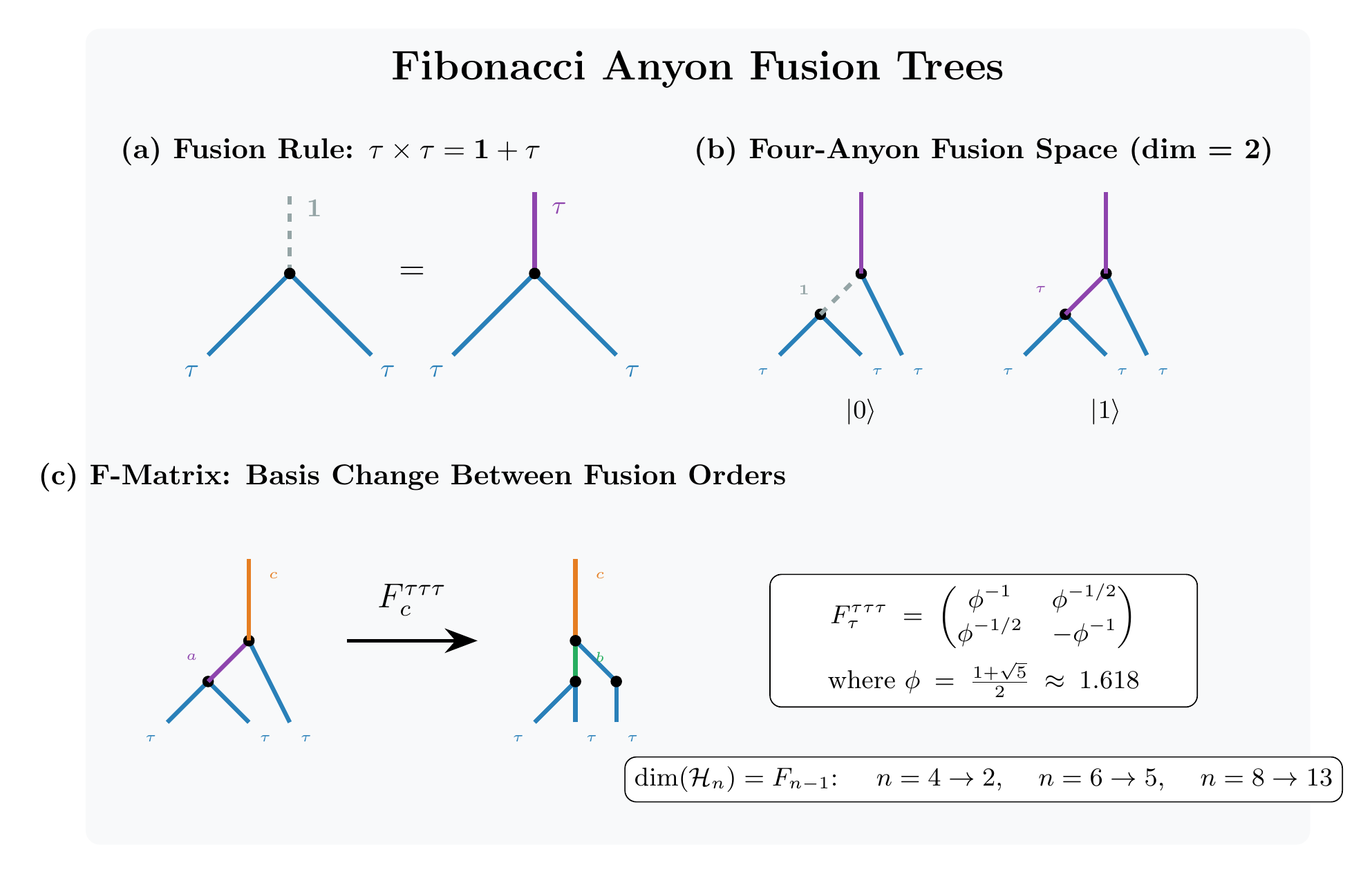
Every anyon model is defined by its fusion rules: what happens when two anyons are brought together. The Fibonacci model has exactly two particle types: the vacuum (nothing) and the Fibonacci anyon .
This single equation encodes the entire computational power of Fibonacci anyons. When two particles are brought together, the outcome is not determined until measurement: they can fuse to vacuum or to another . The two possibilities span a two-dimensional space, which is the foundation for encoding a qubit.
Fibonacci Anyon Fusion Tree
Two Fibonacci anyons (τ) can fuse into either vacuum (1) or another τ anyon. This is the defining equation: τ × τ = 1 + τ
| n anyons | 2 | 3 | 4 | 5 | 6 | 7 | 8 | 10 | 20 | 100 |
|---|---|---|---|---|---|---|---|---|---|---|
| dim(H) | 2 | 3 | 5 | 8 | 13 | 21 | 34 | 89 | 6,765 | ~3.5×10²⁰ |
The Golden Ratio Connection
The name “Fibonacci” comes from the growth rate of the Hilbert space. For Fibonacci anyons, the dimension of the fusion Hilbert space is the -th Fibonacci number:
where is the golden ratio. This is not a coincidence. The Fibonacci anyon model is built on the representation theory of the quantum group , where emerges naturally as the quantum dimension of :
The quantum dimension controls the asymptotic growth of the Hilbert space and determines the total quantum dimension of the theory: . The irrationality of is what makes Fibonacci anyons universal. Anyon types with integer quantum dimensions (like Abelian anyons with ) cannot perform universal computation.
Encoding a Qubit
To encode a single qubit, we use three Fibonacci anyons with a fixed total topological charge of . The two basis states correspond to the two possible outcomes when the first two anyons fuse:
- : the first pair fuses to (vacuum), then vacuum fuses with the third to give total charge .
- : the first pair fuses to , then fuses with selecting the channel to maintain total charge .
This gives a two-dimensional qubit space. For anyons with total charge , the number of qubits scales as : roughly 0.7 qubits per anyon.
Braiding as Computation
The F and R Matrices
The braiding of Fibonacci anyons is completely specified by two matrices. The R-matrix describes the phase acquired when two adjacent anyons are exchanged:
The F-matrix describes the basis change when switching between different fusion orderings (different parenthesizations of multi-anyon fusion):
Both matrices are unitary, and is the golden ratio. Together, these matrices define the braid group representation for Fibonacci anyons.
Braid Group Generators
For a qubit encoded in three anyons, the two elementary braids (generators of ) act as:
The generator swaps the first two anyons (a simple phase in the computational basis), while swaps the second and third anyons, which involves a basis change via because the fusion tree changes structure.
Universality: The Freedman-Larsen-Wang Theorem
The critical result, proven by Michael Freedman, Michael Larsen, and Zhenghan Wang in 2002, is that and together generate a dense subset of SU(2). This means any single-qubit unitary gate can be approximated to arbitrary precision by a finite sequence of braids.
The Solovay-Kitaev theorem guarantees that the approximation is efficient: to achieve precision , the required braid length is for a constant . In practice, a Hadamard gate can be approximated to error with a braid of about 20 exchanges, and to error with about 50 exchanges.
Combined with a two-qubit entangling gate (achieved by braiding anyons between two qubit triplets), this gives full universality. Any quantum algorithm can be compiled into a sequence of braids on Fibonacci anyons.
Fibonacci vs. Ising vs. Abelian Anyons
Not all non-Abelian anyons are created equal. The most discussed alternative to Fibonacci anyons is Ising anyons (closely related to Majorana zero modes), which are the basis for Microsoft’s topological qubit program.
Anyon Type Comparison
| Property | Fibonacci τ | Ising (Majorana) σ | Abelian (e.g., Laughlin) e/3 |
|---|---|---|---|
| Fusion Rule | τ × τ = 1 + τ | σ × σ = 1 + ψ | e/3 × e/3 × e/3 = e |
| Quantum Dimension | φ ≈ 1.618 (irrational) | √2 ≈ 1.414 (irrational) | 1 (integer) |
| Computational Power | Universal (dense in SU(2)) | Clifford group only (not universal) | Not useful for computation |
| Hilbert Space Growth | φⁿ ≈ 1.618ⁿ | 2^(n/2) | 1 (no degeneracy) |
| Extra Gates Needed | None required | Magic state distillation required | N/A (cannot compute) |
| Experimental Status | No confirmed realization | Signatures observed (Microsoft 2025) | Confirmed (Nobel Prize 1998) |
Fibonacci Candidate Systems
- •ν = 12/5 FQHE state
- •Read-Rezayi k=3 states
- •Levin-Wen string-net models
- •Parafermion heterostructures
Ising (Majorana) Candidate Systems
- •ν = 5/2 FQHE state
- •InAs/Al topoconductor nanowires
- •Fe chains on Pb superconductor
- •Vortices in p-wave superconductors
Abelian (e.g., Laughlin) Candidate Systems
- •ν = 1/3 FQHE state
- •Other Laughlin fractions
The practical consequence: Majorana-based topological qubits (Ising anyons) still require a non-topological supplement for universal computation. They can perform Clifford gates by braiding, but need magic state distillation, a resource-intensive protocol, to complete the gate set. Fibonacci anyons do not have this limitation. Everything is topological.
The tradeoff is experimental accessibility. Ising anyons / Majorana zero modes have more candidate material platforms and have progressed further experimentally. Fibonacci anyons remain theoretically predicted but unconfirmed in any laboratory.
Where to Find Fibonacci Anyons
Fractional Quantum Hall States
The most studied candidate is the fractional quantum Hall (FQH) state. This state belongs to the Read-Rezayi series at level , which is theoretically predicted to host Fibonacci anyons. The member of this series is the state (Moore-Read), which hosts Ising anyons. Moving to gives Fibonacci anyons but requires more extreme experimental conditions.
The state has been observed in GaAs/AlGaAs heterostructures at temperatures below 50 mK and magnetic fields around 4-5 T, but it is fragile and difficult to stabilize. Definitive identification of the anyon type requires interferometric experiments that have not yet been performed at this filling fraction.
Read-Rezayi States
The Read-Rezayi parafermion states form a hierarchy indexed by integer :
| Filling | Anyon Type | Computational Power | |
|---|---|---|---|
| 1 | Bosonic (trivial) | None | |
| 2 | Ising (Majorana) | Clifford gates | |
| 3 | Fibonacci | Universal | |
| 4 | More exotic | Beyond Fibonacci |
Each step up in produces more computationally powerful anyons but requires more demanding experimental conditions.
Topological Superconductors and Topoconductors
Microsoft’s approach targets Majorana zero modes (Ising anyons) rather than Fibonacci anyons directly. Their topoconductor platform uses InAs/Al semiconductor-superconductor heterostructures with epitaxial interfaces. The material stack typically involves:
- InAs quantum well: ~7 nm thick, providing the 2D electron gas with strong spin-orbit coupling ( eV·Å)
- Epitaxial Al: ~7-10 nm, inducing superconductivity via the proximity effect
- Gate stack: multiple electrostatic gates for tuning the chemical potential
- Operating temperature: ~20 mK in a dilution refrigerator
In 2025, Microsoft announced devices passing their topological gap protocol (TGP), verifying gap closure and reopening with stable zero-bias conductance peaks consistent with Majorana zero modes. Their proposed tetron qubit uses four Majorana modes to encode one logical qubit.
While this program targets Ising anyons (not Fibonacci), it represents the closest experimental approach to topological quantum computing. Theoretical proposals exist for engineering Fibonacci anyons from paired Majorana modes at fractional quantum Hall edges, but these require even more demanding material quality.
Engineered Lattice Models
The Levin-Wen string-net model with the Fibonacci input category hosts Fibonacci anyons as excitations. Small instances have been simulated on quantum processors (Google, Quantinuum), demonstrating the braiding statistics, but building a scalable physical realization remains an open challenge.
Surface Codes as a Practical Alternative
It is worth noting that surface codes, the leading approach to fault-tolerant quantum computing, achieve similar error protection goals through a fundamentally different mechanism. Instead of encoding information in non-Abelian anyon braids, surface codes use a large lattice of physical qubits with nearest-neighbor stabilizer measurements. Both approaches provide exponential suppression of errors, but surface codes require physical qubits per logical qubit (where is the code distance), while topological codes based on Fibonacci anyons would require only per logical qubit, with the protection coming from the energy gap rather than redundancy.
Recent Experimental Breakthroughs (2023-2025)
Google Quantum AI (2023)
In a landmark experiment published in Nature, Google Quantum AI demonstrated non-Abelian braiding statistics using a superconducting processor. They created and manipulated non-Abelian topological defects in a quantum error-correcting code, verifying that different braiding sequences produce different quantum states. This was the first experimental observation of non-Abelian braiding on a digital quantum processor.
Reference: Andersen, T.I. et al., “Non-Abelian braiding of graph vertices in a superconducting processor,” Nature 618, 264-269 (2023). doi:10.1038/s41586-023-05954-4
Quantinuum (2023)
Working with their H2 trapped-ion quantum processor, Quantinuum created and braided non-Abelian anyons, independently verifying the non-commutativity of exchange operations. Their approach used a digital quantum simulation of the toric code with twist defects.
Reference: Iqbal, M. et al., “Non-Abelian topological order and anyons on a trapped-ion processor,” Nature 626, 505-511 (2024). doi:10.1038/s41586-023-06934-4
Microsoft Azure Quantum (2025)
Microsoft’s long-running topological qubit program reached a milestone when devices based on InAs/Al topoconductor heterostructures passed the topological gap protocol. This verification required observing a hard induced superconducting gap, gap closure and reopening at the topological phase transition, and stable zero-bias conductance peaks from both ends of the wire simultaneously. The tetron qubit architecture, using four Majorana zero modes, is designed for measurement-based braiding without physical T-junction fabrication.
The Golden Ratio in Physics
The golden ratio appears throughout Fibonacci anyon physics, and this is not a coincidence. It is a consequence of the underlying algebraic structure.
The Fibonacci anyon model corresponds to the Chern-Simons topological quantum field theory at level for gauge group . In this theory:
- The quantum dimension of is
- The total quantum dimension is
- The topological entanglement entropy is
- The F-matrix entries are and
- The braiding phases are and , related to the fifth root of unity
The golden ratio also connects to the Jones polynomial in knot theory. The Jones polynomial evaluated at gives the Fibonacci anyon partition function, linking topology, algebra, and physics through a single irrational number.
Impact on Cryptography and Post-Quantum Security
Topological quantum computers, if realized with Fibonacci anyons, would be capable of running Shor’s algorithm with intrinsic fault tolerance. This has direct implications for cryptographic security:
Timeline acceleration: Topological qubits require far fewer physical qubits per logical qubit than surface code approaches. A topological quantum computer could break RSA-2048 with orders of magnitude fewer total qubits than a surface-code machine.
NIST response: The finalization of post-quantum cryptography standards (FIPS 203/ML-KEM, FIPS 204/ML-DSA, FIPS 205/SLH-DSA in August 2024) reflects the urgency of preparing for fault-tolerant quantum computers, regardless of which hardware approach succeeds first.
Quantum entropy: The same quantum physics that enables anyons also provides true randomness via Born’s rule. At QDaria, our Zipminator platform harvests entropy from IBM’s 156-qubit processors to seed post-quantum keys, bridging the gap between today’s NISQ hardware and tomorrow’s topological machines.
Open Questions
Several fundamental questions remain:
Can Fibonacci anyons be created in a laboratory? The FQH state is the most promising natural host, but stabilizing it long enough for braiding experiments remains an unsolved materials challenge.
What is the energy gap? The topological protection is only as strong as the energy gap separating the ground-state manifold from excited states. For the state, theoretical estimates range from 10-100 mK, which is marginal for current dilution refrigerator technology.
Can Fibonacci anyons be engineered rather than discovered? Proposals exist for creating Fibonacci anyons from pairs of Majorana modes at fractional quantum Hall edges, from parafermion zero modes, or from carefully designed lattice models on quantum simulators. None have been demonstrated experimentally.
How does braid compilation scale? While the Solovay-Kitaev theorem guarantees efficient approximation, practical braid compilers for multi-qubit circuits are still an active area of research.
Conclusion
Fibonacci anyons represent the theoretical ideal for topological quantum computing: universal computation through braiding alone, with intrinsic fault tolerance provided by the topology of spacetime. The golden ratio, appearing in the quantum dimension, the Hilbert space growth, and the braiding matrices, connects these exotic quasiparticles to some of the deepest structures in mathematics and physics.
The experimental journey from prediction (1977) to the first demonstrations of non-Abelian braiding (2023) took 46 years. The next phase, creating and manipulating Fibonacci anyons specifically, remains an open challenge. But the theoretical framework is solid, the experimental tools are advancing, and the potential reward, a quantum computer that is naturally immune to decoherence, justifies the effort.
At QDaria, our research program focuses on the theoretical and computational aspects of topological quantum computing: simulating anyon dynamics, optimizing braiding protocols, and developing the quantum reservoir computing framework that connects these ideas to practical machine learning applications. Our TQRC research has already revealed fundamental constraints on how topological systems can be used for computation, findings that shape the direction of the entire field.
The path to Fibonacci anyons is long, but the destination, fault-tolerant quantum computation encoded in the fabric of spacetime, is worth the journey.
References
Leinaas, J. M. & Myrheim, J., “On the theory of identical particles,” Il Nuovo Cimento B 37, 1-23 (1977). doi:10.1007/BF02727953
Wilczek, F., “Quantum Mechanics of Fractional-Spin Particles,” Phys. Rev. Lett. 49, 957 (1982). doi:10.1103/PhysRevLett.49.957
Moore, G. & Read, N., “Nonabelions in the fractional quantum hall effect,” Nuclear Physics B 360, 362-396 (1991). doi:10.1016/0550-3213(91)90407-O
Kitaev, A., “Fault-tolerant quantum computation by anyons,” Annals of Physics 303, 2-30 (2003). doi:10.1016/S0003-4916(02)00018-0
Freedman, M. H., Larsen, M. & Wang, Z., “A Modular Functor Which is Universal for Quantum Computation,” Commun. Math. Phys. 227, 605-622 (2002). doi:10.1007/s002200200645
Nayak, C. et al., “Non-Abelian anyons and topological quantum computation,” Rev. Mod. Phys. 80, 1083-1159 (2008). doi:10.1103/RevModPhys.80.1083
Trebst, S. et al., “A Short Introduction to Fibonacci Anyon Models,” Prog. Theor. Phys. Suppl. 176, 384-407 (2008). doi:10.1143/PTPS.176.384
Bonesteel, N. E. et al., “Braid Topologies for Quantum Computation,” Phys. Rev. Lett. 95, 140503 (2005). doi:10.1103/PhysRevLett.95.140503
Andersen, T. I. et al., “Non-Abelian braiding of graph vertices in a superconducting processor,” Nature 618, 264-269 (2023). doi:10.1038/s41586-023-05954-4
Iqbal, M. et al., “Non-Abelian topological order and anyons on a trapped-ion processor,” Nature 626, 505-511 (2024). doi:10.1038/s41586-023-06934-4